
For generations, Bible students have used concordances to locate passages, trace words, and examine the vocabulary of Scripture. Before electronic Bible software made word searches almost instantaneous, a good concordance was one of the most important reference books beside the Bible itself.
Among English-speaking Christians, three works have achieved particular prominence: Cruden’s Complete Concordance, Strong’s Exhaustive Concordance of the Bible, and Young’s Analytical Concordance to the Bible. Although all three serve the basic purpose of locating words in Scripture, they were designed differently and are not equally suited to every kind of study.
Cruden’s Concordance
Cruden’s Concordance was the work of Alexander Cruden (1699–1770), a Scottish-born scholar and bookseller. The first edition of his Complete Concordance to the Holy Scriptures appeared in 1737. Revised editions followed during Cruden’s lifetime, and the work eventually became one of the most widely used Bible reference books in the English-speaking world.
Cruden worked principally with the text of the King James Version. His concordance lists important English words found in the Bible and provides references showing where those words occur. It also contains brief explanatory material concerning certain biblical names, persons, places, and terms.
The great virtue of Cruden is its simplicity. A reader who remembers part of a verse but cannot remember its location can often find it quickly by looking up one of its principal words. It is therefore particularly useful as a general reference concordance.
Its weakness is that it is not exhaustive in the same sense as Strong’s, nor is it designed primarily for detailed study of the Hebrew and Greek vocabulary underlying the English translation. For ordinary Bible reading, however, its compactness can actually be an advantage.
Strong’s Exhaustive Concordance
Strong’s Exhaustive Concordance of the Bible was prepared under the direction of James Strong (1822–1894), an American Methodist biblical scholar. Strong was a professor of exegetical theology and was also involved in the American revision of the King James Bible that resulted in the American Standard Version.
His monumental concordance was first published in 1890 under the title The Exhaustive Concordance of the Bible. Its purpose was considerably more ambitious than that of Cruden: Strong sought to provide an exhaustive index of the words of the King James Version.
Strong’s most influential innovation was his numbering system. Every principal Hebrew and Greek word was assigned a number—now universally known as a Strong’s number. Thus, a reader who knows no Hebrew or Greek can identify the original word lying behind an English word and can trace other occurrences of that same original term.
The numbering system became so useful that it long outlived the printed concordance itself. Strong’s numbers are now incorporated into numerous lexicons, interlinear Bibles, computer programs, websites, and Bible-study applications.
Strong’s chief strength, therefore, is its ability to act as a bridge between the English Bible and the original languages. Its principal weakness is that inexperienced students can mistake the short dictionary definitions attached to Strong’s numbers for complete lexical analysis. They are not. The meaning of a Hebrew or Greek word must ultimately be determined by grammar, context, usage, and sound lexicography—not simply by choosing a definition from a list.
Young’s Analytical Concordance
Young’s Analytical Concordance to the Bible was produced by Robert Young (1822–1888), the Scottish biblical scholar best remembered for Young’s Literal Translation of the Bible. The concordance was first published in 1879 and was subsequently revised and enlarged.
Young’s work differs significantly from both Cruden and Strong. It is called an “Analytical” Concordance because it does more than merely list occurrences of English words. It arranges them according to the different Hebrew and Greek words from which they were translated.
This is extremely valuable because one English word in the King James Version may represent several different Hebrew or Greek words. Conversely, one Hebrew or Greek word may be translated by several different English words. Young’s organisation enables the student to see these distinctions more readily.
Suppose, for example, that an English word occurs many times in Scripture. Cruden may help the reader locate the passages, while Strong enables the reader to identify the underlying original words by number. Young, however, groups the occurrences analytically according to those underlying words. This makes the structure of the translation more immediately visible.
Young’s great strength is therefore word analysis. Its weakness is that its arrangement can initially appear more complicated than Cruden’s, particularly to a beginner. It also lacks the enormous modern ecosystem that has developed around Strong’s numbering system.
Comparison of the Three Concordances
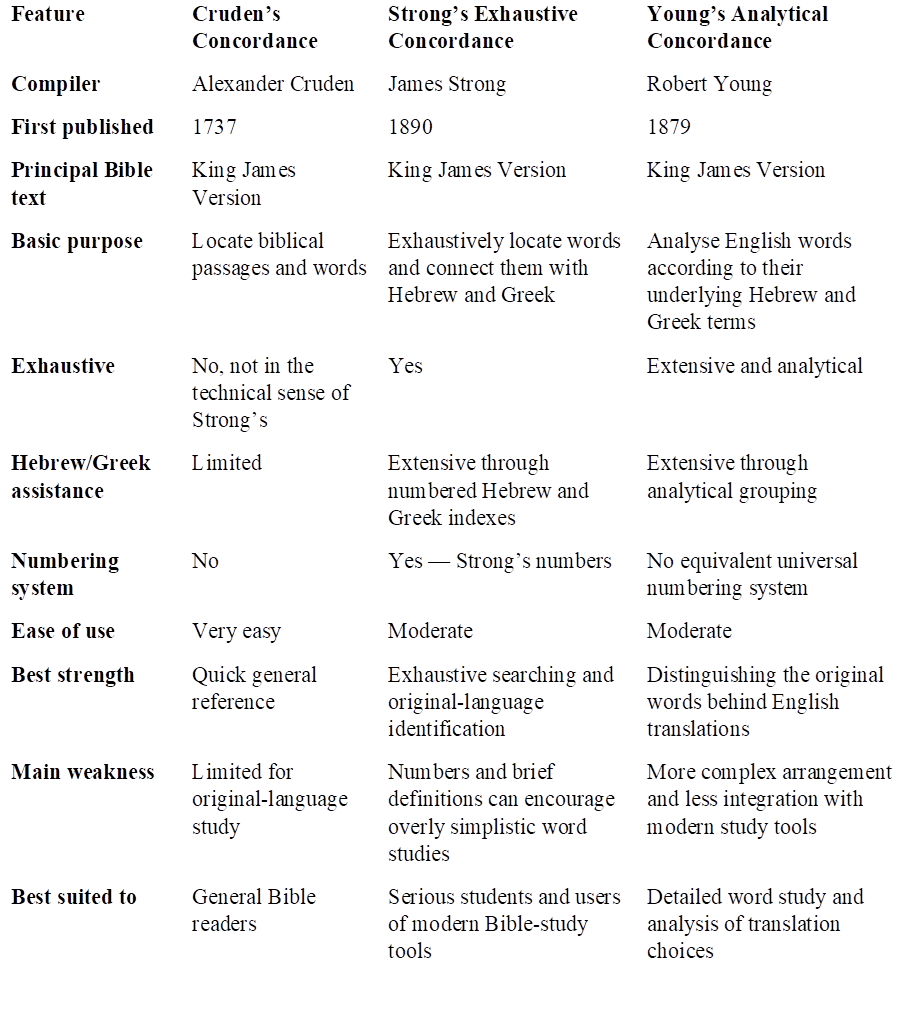
Which Is the Best?
If only one of these three concordances were to be purchased for serious Bible study, Strong’s Exhaustive Concordance is the most useful all-round choice.
Its advantage is not merely that it is exhaustive. The decisive feature is the Strong’s numbering system. Because those numbers have become a standard means of identifying Hebrew and Greek words in resources designed for readers who do not know the biblical languages, Strong’s can serve as the starting point for a much wider range of study. A Strong’s number can lead from the concordance to lexicons, interlinear texts, dictionaries, electronic resources, and other reference works.
Nevertheless, Young’s is arguably the better concordance for analytical word study within the printed volume itself. Its arrangement allows the student to see immediately that a particular English word may represent several different Hebrew or Greek terms. For careful study of the wording of the King James Version and its relationship to the original languages, Young’s remains exceptionally valuable.
Cruden’s occupies a different place. It is the least powerful of the three for technical study, but it is also the most straightforward. For locating a remembered phrase or finding passages containing a particular English word, it remains an excellent traditional reference work.
The three may therefore be summarised simply: Cruden’s helps you find the English word. Strong’s helps you identify the original word. Young’s helps you analyse how the original words have been translated.
For a serious Bible student, Strong’s and Young’s are complementary rather than competing works. Strong’s provides the greater overall utility, especially because of the widespread adoption of its numbering system, while Young’s often provides the clearer printed presentation for analytical word study. Cruden’s remains valuable for straightforward reference work and as an important monument in the history of English Bible study.
One caution should accompany the use of all three. A concordance is a reference tool, not an interpreter of Scripture. Word studies must remain subordinate to the grammatical and historical context of the passage. A Hebrew or Greek word does not carry every possible dictionary meaning into every verse in which it occurs. Used carefully, however, these concordances remain valuable aids to the principle of comparing Scripture with Scripture and examining the words through which the biblical text has been transmitted.






Leave a Reply