

Few national flags are as recognisable as the British Union Flag. Its bold arrangement of red, white, and blue has become known throughout the world, carried across oceans, flown over battlefields, raised above government buildings, and displayed at moments of national celebration and mourning. More commonly called the Union Jack, it is not merely an attractive national emblem. Its design tells a story.
That story is one of kingdoms becoming united, of political struggles and changes, and of the complicated relationship between England, Scotland, Ireland, and Wales. Yet there is another feature of the flag which is sometimes overlooked. At the heart of its design are three crosses traditionally associated with Christian saints.
The British flag therefore carries within it something of the Christian history of these islands. Whatever Britain may become in the future, the flag remains a visible reminder of the beliefs, traditions, conflicts, and unions which helped to shape the nation.
Before There Was a British Flag
For most of British history there was no British flag because there was no single political state called Great Britain or the United Kingdom.
England and Scotland developed as separate kingdoms. Wales had its own princes and kingdoms before coming under English rule, while Ireland possessed a complicated collection of native kingdoms and lordships before increasing English and later British involvement.
Flags as we understand them today also developed gradually. Medieval kings, nobles, armies, and ships used banners, standards, coats of arms, and religious emblems to identify themselves. The modern idea of a national flag belonging to an entire people was still developing. The story of the Union Flag must therefore begin with the symbols which eventually became part of it.
The Cross of St George and England
The English contribution to the Union Flag is the Cross of St George: a red upright cross upon a white background.
St George is traditionally regarded as the patron saint of England, although he was not English. According to Christian tradition, George was a Roman soldier and Christian martyr who probably lived during the late third and early fourth centuries. Tradition associates his martyrdom with the persecution of Christians under the Roman emperor Diocletian.
The familiar story of St George killing a dragon developed much later. The dragon became a symbol of evil, while George represented Christian courage and the triumph of good over evil.
Devotion to St George became increasingly important in medieval England, particularly during and after the Crusading period. By the later Middle Ages he had become firmly established as England’s principal patron saint.
The red cross of St George consequently became closely associated with England.
Its religious character should not be missed. To medieval Christians, a cross was not merely a convenient geometrical symbol. It immediately called to mind the crucifixion of Jesus Christ.
For Christians, the cross represents both suffering and victory. Christ was crucified, yet Christians believe that He rose bodily from the dead and conquered death. As the Apostle Paul wrote in Galatians 6:14, “But God forbid that I should boast except in the cross of our Lord Jesus Christ.”
Whatever political uses the Cross of St George later acquired, its origins belong to a society in which Christianity profoundly influenced public life.

Scotland and the Cross of St Andrew
Scotland contributed another ancient Christian emblem: the Saltire, or Cross of St Andrew.
Unlike the upright Cross of St George, St Andrew’s Cross is diagonal and shaped like the letter X. On the Scottish flag it appears as a white saltire against a blue field.
Andrew occupies an important place in the New Testament. He was the brother of Simon Peter and one of the twelve apostles of Jesus Christ.
John’s Gospel records Andrew bringing Peter to Christ, “He first found his own brother Simon, and said to him, ‘We have found the Messiah’ (which is translated, the Christ)” (John 1:41).
That small detail gives Andrew a particularly attractive place in Christian history: he was a man who brought another person to Jesus. Later Christian tradition held that Andrew was martyred by crucifixion and eventually associated his death with a diagonal cross. Although the historical details surrounding the form of his martyrdom are uncertain, the saltire became firmly connected with him.
Traditions linking St Andrew with Scotland are ancient, and his symbolism became deeply embedded in Scottish national identity. Thus, before England and Scotland shared a flag, both kingdoms possessed flags dominated by the symbol of the Christian cross.

1603: Two Crowns, One King
The event which eventually produced the Union Flag occurred in 1603. Queen Elizabeth I of England died without children. The English throne passed to James VI of Scotland, who consequently also became James I of England. James was now king of both England and Scotland. This event is commonly known as the Union of the Crowns.
It is important, however, not to confuse this with the later political union of the countries. England and Scotland remained separate kingdoms. They retained separate parliaments, legal systems, and national institutions. Nevertheless, they now shared one monarch. James strongly favoured closer unity between his kingdoms and adopted the style of King of Great Britain, although the complete parliamentary union he desired did not occur during his lifetime.
The new situation created a practical problem, particularly at sea. If English ships displayed St George’s Cross and Scottish ships displayed St Andrew’s Cross, what emblem should represent ships serving the king who ruled both kingdoms? The answer was to combine the two.
The First Union Flag of 1606
In 1606, a new flag was introduced combining the Cross of St George with the Cross of St Andrew. The red upright English cross appeared together with the white diagonal Scottish cross against a blue field. The essential idea behind the Union Flag had been born.
It was a remarkably effective piece of symbolism. Instead of abandoning one national emblem in favour of another, the two were placed together. The flag visually expressed the idea of union without complete disappearance of identity. England remained England. Scotland remained Scotland. Yet the crowns had been united in one monarch. This principle would continue as the flag developed.

The Union of England and Scotland in 1707
The next decisive event occurred a century later. Under the Acts of Union of 1707, England and Scotland were politically united into a single kingdom: the Kingdom of Great Britain. The English and Scottish parliaments ceased to exist as separate sovereign legislatures, and a new Parliament of Great Britain sat at Westminster. The Union Flag consequently became the flag of the new British state.
This union was not universally welcomed. Political calculation, economic interests, dynastic concerns, religion, and international security all played their part in the negotiations. Opposition existed on both sides of the border, and particularly strong resentment was found among sections of the Scottish population. Yet the union endured.
During the eighteenth century Britain grew into one of the world’s major commercial, naval, military, and imperial powers. The Union Flag increasingly travelled with British ships and soldiers around the world.
Ireland and the Cross of St Patrick
The modern Union Flag did not appear until the beginning of the nineteenth century. In 1801, another political union took effect, joining the Kingdom of Great Britain and the Kingdom of Ireland to form the United Kingdom of Great Britain and Ireland. A further symbol was therefore incorporated into the flag. This was the Cross of St Patrick, represented as a red diagonal saltire upon a white background. Patrick is traditionally regarded as the patron saint of Ireland and one of the most important figures in the history of Christianity in the British Isles.
Born in Roman Britain, Patrick was taken captive and carried to Ireland as a slave. After escaping, he eventually returned to Ireland as a Christian missionary. The Christianity associated with Patrick was strongly missionary in character. His life has become a powerful example of courage, forgiveness, and evangelistic determination. The red saltire associated with Patrick was incorporated with the existing crosses of George and Andrew. On 1 January 1801, the redesigned Union Flag came into use. This is essentially the flag Britain still uses today.

Why the Diagonal Crosses Look Uneven
At first glance, the modern Union Flag can appear slightly irregular. The red diagonal Cross of St Patrick does not simply sit symmetrically in the middle of the white Cross of St Andrew. Instead, the red and white diagonal elements are offset. This is deliberate. The arrangement allows both St Andrew’s white saltire and St Patrick’s red saltire to remain distinguishable rather than allowing one simply to cover the other.
It also means that the Union Flag has a correct way up. Flying it upside down is therefore an error, despite the common assumption that the design looks identical whichever way it is turned. The asymmetry is part of the historical logic of the flag: several national symbols have been superimposed while retaining their individual identity.

Wales: The Nation Missing from the Union Flag
One question naturally arises when the Union Flag is examined: Where is Wales? England is represented by St George. Scotland is represented by St Andrew. Ireland is represented through St Patrick. Yet there is no Welsh dragon and no Cross of St David. This sometimes leads to the mistaken conclusion that Wales was simply forgotten. The real explanation lies in political history.
By the time the first Union Flag appeared in 1606, Wales had already been legally incorporated with England through legislation enacted during the reign of Henry VIII, particularly the Laws in Wales Acts of 1535 and 1542. Consequently, when England and Scotland were represented in the new flag, Wales was not treated as a separate kingdom entering into a new union. For the political purposes of the period, it was represented together with England. That explains the absence, although it does not necessarily satisfy those who would like to see Wales represented separately today.
The Welsh Flag and the Red Dragon
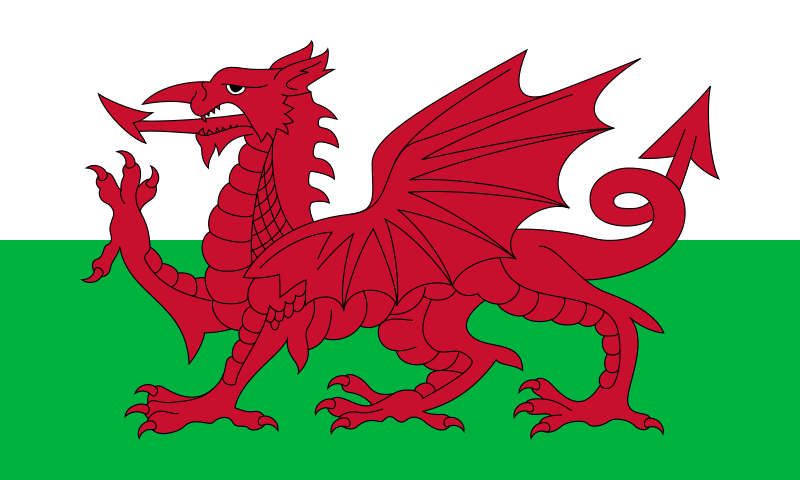
Wales possesses one of the most distinctive national flags in the world. The Welsh flag, Y Ddraig Goch, features a great red dragon upon a green and white background. The dragon has ancient associations with Wales and Welsh identity. Dragon imagery existed in Britain long before the creation of the modern Welsh flag and became associated with Welsh rulers and traditions.
The Tudor dynasty strengthened the prominence of the red dragon. Henry VII, who possessed Welsh ancestry, used a red dragon standard at the Battle of Bosworth in 1485. Following his victory and accession to the throne, the dragon gained further royal significance. The modern Welsh national flag combines the red dragon with the Tudor colours of green and white. It is striking that Wales, although absent as a distinct element of the Union Flag, possesses perhaps the most immediately dramatic flag of any nation within the United Kingdom.
St David and the Christian Heritage of Wales
There is also another Welsh emblem which would fit naturally into the Christian symbolism of the Union Flag: the Cross of St David. St David, or Dewi Sant, is the patron saint of Wales. He was a sixth-century Christian bishop associated with the growth of Christianity in Wales. Tradition portrays David as a disciplined Christian leader who emphasised prayer, simplicity, hard work, and holy living. Monastic communities connected with his influence became centres of Christian worship and learning.
St David’s Cathedral in Pembrokeshire stands as one of the great surviving reminders of this Welsh Christian inheritance. The flag associated with St David normally consists of a yellow or gold cross upon a black field. It does not possess the same official status as the Welsh Red Dragon flag, but it has become an increasingly familiar expression of Welsh identity. Had Wales entered the political union as a separate kingdom in the seventeenth or eighteenth century, it is intriguing to imagine how a Welsh emblem might have been incorporated into the Union Flag.
Is It the Union Flag or the Union Jack?
Both names are widely understood, although there has long been debate about terminology. One traditional explanation claims that Union Jack should technically refer only to the flag when flown from a ship, while Union Flag should be used on land.
The word jack certainly has strong naval associations, referring to a particular type or position of flag flown aboard a vessel. However, the expression “Union Jack” has been used more broadly for a very long time and is now entirely normal as a name for the national flag. Thus calling it the Union Flag is correct, and calling it the Union Jack is also accepted usage.
Northern Ireland and the Flag Today
The political geography represented by the flag changed dramatically during the twentieth century. Following the partition of Ireland and the establishment of the Irish Free State, most of Ireland ceased to be part of the United Kingdom. Northern Ireland remained within it. In 1927, the state’s formal name became the United Kingdom of Great Britain and Northern Ireland. Yet the Union Flag was not redesigned. The Cross of St Patrick remained.
A Flag Formed from Christian Crosses
Perhaps the most remarkable feature of the British flag is one so obvious that it is easily overlooked. It is made from crosses. Not one cross, but three. At its centre stands the Cross of St George. Behind it lies the Cross of St Andrew, while the Cross of St Patrick is woven into the same design. The Union Flag therefore cannot be fully explained without discussing Christianity.
This does not mean that every person who created, carried, or fought beneath the flag was motivated by Christian faith. British history contains much that Christians can admire and much that Christians should condemn. National history should never be turned into mythology.
Nor should Christianity be confused with patriotism. The New Testament does not teach that any earthly nation possesses a permanent covenant status equivalent to biblical Israel. A Christian’s highest allegiance is not to a flag, monarch, parliament, or country, but to Jesus Christ.
Paul wrote, “For our citizenship is in heaven, from which we also eagerly wait for the Savior, the Lord Jesus Christ” (Philippians 3:20). Nevertheless, historical honesty requires recognition that Christianity profoundly influenced the civilisation from which the United Kingdom emerged.
Its churches and cathedrals shaped towns and cities. Biblical language entered literature and ordinary speech. Christian ideas influenced law, education, charity, family life, burial customs, public ceremonies, and concepts of duty and morality. Kings were crowned in Christian services, Parliament opened with prayer, and generations of British men and women learned Scripture in churches, chapels, Sunday schools, and homes. Even Britain’s national flag bears unmistakable evidence of that inheritance.
The Bible and British History
The Christian dimension of British history extends far beyond the design of the flag. The translation and distribution of the Bible had an enormous effect upon British religious and cultural life. The work of men such as William Tyndale, who paid with his life for his commitment to making Scripture available in English, helped transform the spiritual landscape of the country. The Authorised Version of 1611, commonly known as the King James Version, subsequently exercised an extraordinary influence upon English-speaking Christianity, literature, and language. Britain later became one of the great centres of the modern missionary movement. Missionaries travelled throughout the world preaching Christ, translating Scripture, establishing schools, and founding hospitals and charitable institutions.
Figures such as William Carey, Hudson Taylor, David Livingstone, George Müller, and many others belonged to a religious culture in which the authority of Scripture and the responsibility to spread the Gospel were taken with great seriousness. British Christian history was never perfect. No national history is. Yet neither should its genuine Christian achievements be erased simply because later generations view the past differently.
Christianity, Patriotism, and National Humility
There is nothing inherently wrong with loving one’s country. The Christian may appreciate his national inheritance, honour those who sacrificed for the liberties he enjoys, preserve what is worthy from previous generations, and pray for those who govern him. Scripture itself teaches believers to pray for rulers and those in authority. 1 Timothy 2:1–2 says, “Therefore I exhort first of all that supplications, prayers, intercessions, and giving of thanks be made for all men, for kings and all who are in authority.”
Yet Christianity also prevents patriotism from becoming idolatry. No nation is the Kingdom of God. No national flag is the banner of the Gospel. Nations rise and fall, governments change, borders move, and empires disappear. Jesus Christ remains. That distinction is particularly important when considering Britain’s past. Christians need neither despise their national history nor romanticise it. They can give thanks for what was good, acknowledge what was wrong, and seek to preserve those principles which remain true.
More Than Red, White, and Blue
The Union Flag is therefore far more than a colourful national emblem. Its development records several major stages in the creation of the United Kingdom: the Union of the Crowns in 1603, the first Union Flag in 1606, the political union of England and Scotland in 1707, and the incorporation of the Cross of St Patrick following the union with Ireland in 1801.
Its absence of a specifically Welsh element tells another part of the story, the earlier incorporation of Wales into the English political system, while the Red Dragon continues to proclaim Wales’s distinct national identity.
Above all, the Union Flag carries an unmistakable reminder of Britain’s Christian past. St George, St Andrew, and St Patrick belong to Christian tradition. St David stands at the heart of the Christian heritage of Wales. The crosses upon the flag point backwards through centuries in which Christianity played a central role in the formation of British society.
Modern Britain is considerably different from the country in which the Union Flag developed. Religious belief has changed, the Empire has disappeared, society has become more secular and more diverse, and debates concerning the future constitutional relationship of the nations continue. Yet the flag remains. When it flies above a public building, is carried at a national ceremony, or is raised in remembrance of those who died in war, it carries centuries of history with it.
A flag cannot preach the Gospel, and a nation cannot be made Christian merely by placing crosses upon its banner. Nevertheless, those crosses are there because Christianity was there. They are stitched into the national emblem just as Christian influence is stitched into British history.
To understand the Union Flag properly, therefore, is to understand something of England, Scotland, Ireland, and Wales; something of monarchy, parliament, war, union, and national identity; and something of the Christian civilisation in which the flag itself was born. The Union Flag is ultimately a symbol of union, different histories brought together without entirely losing their distinction. Its crosses remind us of the generations who came before us, while its continued presence challenges each generation to consider what inheritance it has received and what inheritance it will leave behind.
As Scripture wisely observes in Psalm 145:4, “One generation shall praise Your works to another, And shall declare Your mighty acts.” Nations change. Flags change. Kingdoms rise and pass away. But the Christian knows that beyond every earthly kingdom stands one Kingdom that cannot be shaken, and beyond every human ruler stands the King of kings. That truth provides the proper perspective from which Christians may appreciate their national heritage: gratefully, thoughtfully, and with their ultimate allegiance fixed not upon the kingdoms of men, but upon Jesus Christ.






Leave a Reply